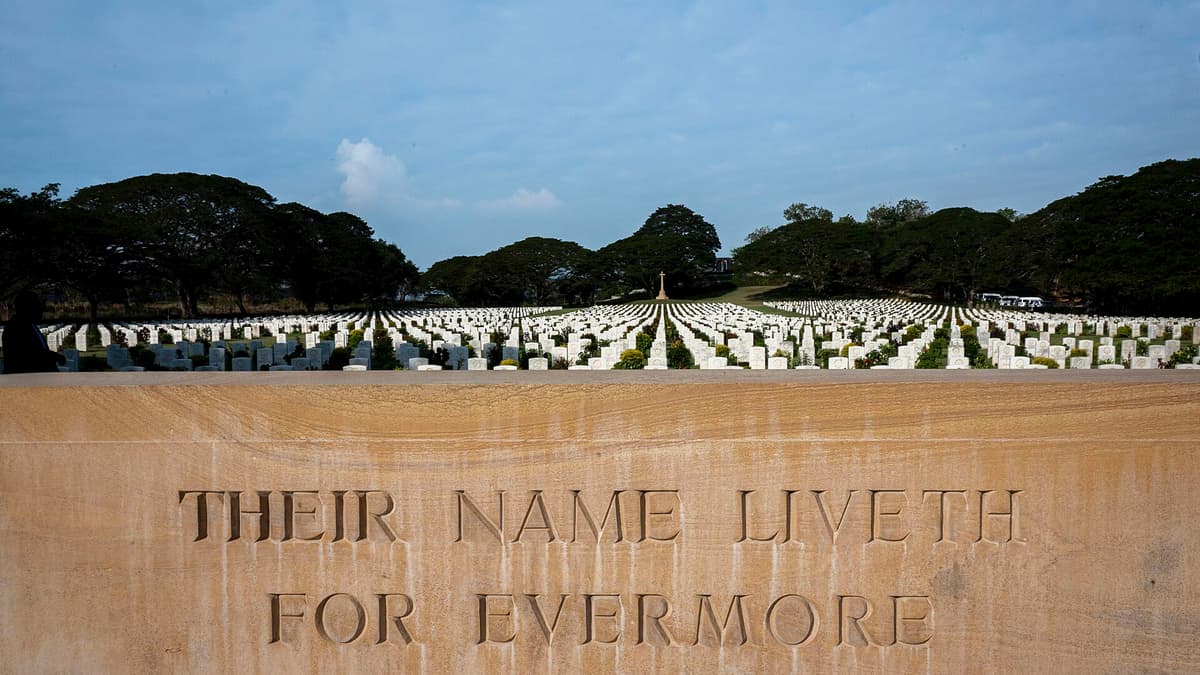
Port Moresby (Bomana) War Cemetery is the largest war cemetery in Papua New Guinea. It lies about 19 km north of the city, on the road past Nine Mile, and is cared for by the Commonwealth War Graves Commission. Rows of white headstones run across the lawns between big shade trees, and it is one of the quietest places near the capital.
Who is buried here
The cemetery holds 3,824 Commonwealth servicemen of the Second World War, 699 of whom are unidentified. Most died in the fighting in Papua, including on the Kokoda Track, at Milne Bay and on the north coast, and some on Bougainville. Most were Australian, and more than 600 Indian soldiers are also buried here.
Among the graves are two Victoria Cross recipients: Private Bruce Kingsbury, who fell at Isurava on the Kokoda Track in August 1942, and Corporal John French, who fell at Milne Bay that September.
The Port Moresby Memorial
Inside the cemetery, the Port Moresby Memorial is a rotunda of stone pillars carrying bronze panels. They name more than 700 men of the Australian Army, including Papuan and New Guinea local forces, the Australian Merchant Navy and the Royal Australian Air Force who died in Papua and have no known grave. A bronze compass sits on a stone table at the centre.
Visiting
- Go with a driver or guide, and be back in the city before dark.
- The cemetery is usually staffed at the gate. Be courteous, and follow any instructions.
- Dress respectfully, keep voices low, and don’t climb on headstones or memorials.
- Allow an hour, more if you are looking for a particular grave.
- To find a grave, search the Commission’s online records before you go. They give the plot, row and grave.
- Bring water and a hat. There is little shade between the rows in the middle of the day.
Bomana is on the way to the Sogeri Plateau, so many visitors stop here on a day trip to Varirata, Rouna Falls and Owers’ Corner.
ANZAC Day dawn service
ANZAC Day, on 25 April, remembers the Australians and New Zealanders who served and died in war. The Australian High Commission holds dawn services across Papua New Guinea, and the largest is at Bomana. In 2026, 4,879 people attended, more than at the dawn service at Gallipoli that year. In 2027 ANZAC Day falls on a Sunday.
- Check the time and arrangements with the Australian High Commission in the weeks before.
- Arrange transport with your hotel, as the service starts before dawn. Leave early, as thousands attend.
- Dress respectfully. Many people wear medals belonging to themselves or family members.
- Hotels and Kokoda treks fill up around ANZAC Day, so book early. See where to stay.
Papua New Guinea’s own National Remembrance Day, on 23 July, honours Papua New Guinean servicemen and women. See what’s on for dates.
The story behind it
In 1942 Port Moresby was the main Allied base in New Guinea, and Japanese forces tried to take it by sea and then overland across the Owen Stanley Range. Our guide to Port Moresby’s wartime history tells the story. Another dawn service is held at Lae War Cemetery, in Papua New Guinea’s second city.
General information, checked against public sources in November 2026. Conditions change, so confirm the details locally before you travel.